
If you're interviewing financial advisors, this is an episode you won’t want to miss.
Financial advisors are like anything else you spend money on: there are a lot of options and features. The tricky part is knowing which features actually matter to you.
One of my clients gave a great example of this. As a first-time parent, she found choosing a stroller overwhelming. There were so many options that it took her a month to decide.
Hopefully, this episode helps you save some time when searching for the perfect advisor for you.
1. Are you a fiduciary?
A fiduciary standard means an advisor has to put your best interest ahead of their own.
Some of you might be shocked that advisors have to operate in your best interest because you’ve heard stories or seen movies like The Wolf of Wall Street.
Others might be shocked to learn that not all advisors have that requirement. I was in this boat.
The suitability standard is what brokerage advisors are generally required to follow. This means they can make recommendations that are reasonably suitable for you, even if they get paid more or the recommendation isn't truly the best option for your situation.
Another way to think about it—and I’m borrowing this comparison from financial advisor resource Michael Kitces—is buying an outfit.
If a store representative is helping you purchase an outfit, the difference is that a fiduciary will make sure you look great in it, while a suitability standard may simply find you something that fits okay.
Beware of hybrids. They aren't necessarily bad, but they can make things confusing. They may change hats while working with you, and it isn't always easy to understand when they're acting as a fiduciary in your best interest versus when they're wearing their sales hat and recommending something suitable.
Advisors at many large companies, like Edward Jones, Fidelity, or Vanguard, tend to fall into the hybrid category.
2. What types of clients do you specialize in?
General financial planners can handle common financial questions, especially if they have a designation like the CFP, which is considered the gold standard for comprehensive financial planning.
If you have a unique circumstance, you may benefit from an advisor who serves clients similar to you.
The tech professionals I serve tend to work with me because of my specialized background in stock options and advanced tax planning. I understand the unique landscape in tech, including hiring sprees and severance packages.
Other advisors specialize in business owners, teachers, widowers, childless clients, and other specific groups.
3. What areas of financial planning do you provide value in?
There's a common perception that a financial advisor's greatest value comes from investment selection. Part of the reason is that the majority of financial advisors primarily help with investments.
Luckily, there's a growing number of comprehensive financial planners who can help with other areas of your financial life, including debt management, student loans, budgeting, stock compensation, tax planning, retirement, insurance, and estate planning.
In the financial planning world, there's a pyramid that illustrates the hierarchy of advisor value. Investments are actually on the lower end.
At the base, where the most value can be provided, are consistent and increased savings, encouraging investment, financial planning, and managing expectations and behavior. Only then do you get to investments: asset allocation, managing fees, portfolio rebalancing, and individual stock selection.
4. What is your cost structure?
Fee-Only
This is generally the most transparent cost structure because you pay the advisor directly. Fees can take the form of a percentage of assets under management, a flat fee, an hourly rate, or a monthly retainer.
Fee-Based
A fee-based advisor may charge transparent fees but can also be compensated through commissions and sales, which can make the total cost harder to understand.
Free (Commission)
You don't pay anything directly. By now, most people know this is often a sales tactic: the cost is hidden in the product you're being sold.
If you need the product, understand where the cost is hidden, and believe the cost is reasonable, it may still be a good fit.
5. What happens if you leave the company?
At this point, you probably know whether the advisor can solve your immediate needs. But what happens as your life evolves and things change?
Will they likely still be your advisor, or will you be handed off to another advisor as they move up? What happens if they leave the company?
You're going to spend a lot of time and energy building a trusted relationship, so you should understand the possibility that you won't be in control of when that relationship ends.
If the advisor you're working with isn't independent, there's a higher probability that they may move up or out. Advisors within larger corporations can be overworked or required to work in ways they don't believe are the best way to serve their clients.
On the other hand, you may like knowing that the financial advising machine is bigger than the individual advisor you're working with. You may not mind having a new advisor rotate in to help with your financial planning.
Those are the five questions to ask to find the perfect advisor for you:
- Are you a fiduciary?
- What types of clients do you specialize in?
- What areas of financial planning do you provide value in?
- What is your cost structure?
- What happens if you leave the company?
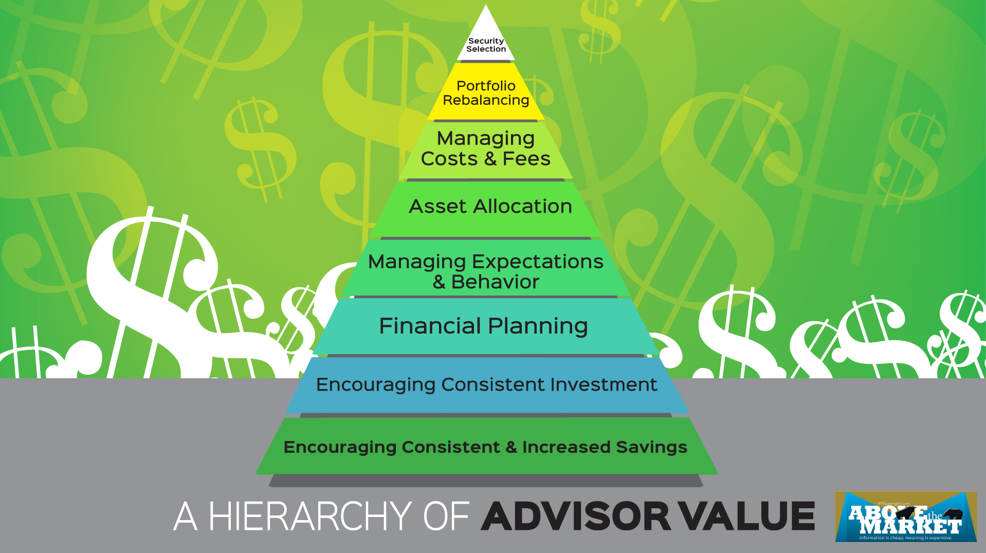
Investment management is not the only value financial advisors provide.
Better financial habits compound and can change the trajectory of your wealth building, as well as, your financial confidence.

What's The Difference in Fiduciary Standard vs. a Suitability Standard?
Michael Kitces uses the following example: "Suitability means selling a suit that fits you. Fiduciary duty means it actually has to look good on you, too."
